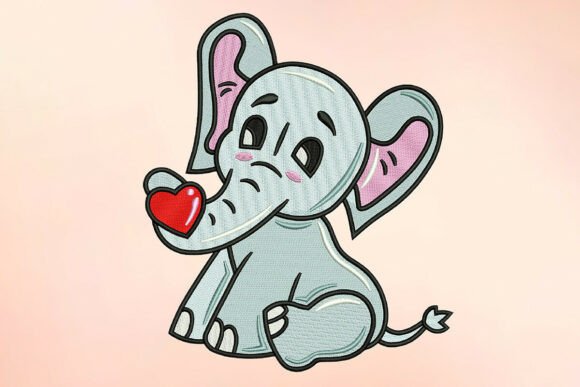
Shy Elephant with Heart Embroidery
A Warm, Trust-Building Brand Mark for Small Business Merch
As an embroidery designer who’s developed hundreds of commercial designs for cafés, boutiques, pet brands, florists, and handmade studios, my first impression of Shy Elephant with Heart Embroidery is immediate and positive: it reads as friendly, approachable, and quietly confident—not cutesy or childish, but emotionally resonant. The “shy” descriptor isn’t passive; it suggests warmth, empathy, and gentle strength—qualities that align powerfully with values-driven small businesses. This isn’t just a cartoon elephant—it’s a brand whisperer. In the Baby Animals category, it stands apart by balancing softness with clean visual structure, making it far more versatile than typical nursery-themed motifs.
Where It Shines in Real Business Applications
Shy Elephant with Heart Embroidery excels where emotional connection meets practical durability. On staff aprons for a local bakery or floral studio, it adds personality without overwhelming the garment—positioned neatly above the pocket or subtly on the chest, it reinforces hospitality and care. As an embroidered patch, it’s ideal for attaching to tote bags, denim jackets, or reusable produce sacks sold at farmers’ markets or boutique shops. Its compact silhouette holds up beautifully at 2.5"–3.5" widths, maintaining legibility and charm even after repeated washing.
For cap embroidery, place it centered on the front panel (not too low)—its rounded contours adapt well to curved surfaces when digitized with proper underlay and reduced pull compensation. On uniforms for a pet-sitting service or children’s wellness studio, it signals compassion without leaning into cliché. And as a sleeve detail on work shirts or a subtle tag accent on handmade product packaging, it becomes a quiet signature—a tactile reinforcement of brand identity that customers remember.
Smart Placement & Size Considerations
While Shy Elephant with Heart Embroidery is highly adaptable, precision matters. Avoid scaling it below 1.75" for patches or cap fronts—its delicate heart and expressive eye detail risk blurring or stitching distortion. On textured fabrics like canvas tote bags or heavy twill aprons, confirm the stitch density isn’t overly tight; excessive density can cause puckering or thread breakage during production. Likewise, on dark uniforms (navy, charcoal, deep burgundy), verify thread color contrast—light pinks or creams may fade visually unless paired with high-contrast underlay or slightly brighter tones.
Curved surfaces (like cap fronts or rolled sleeves) demand careful digitizing: look for smooth satin column transitions and balanced fill angles. If your digital embroidery file lacks these refinements, request a revision before bulk production. Also, avoid placing it directly over seams or high-flex zones (e.g., elbow joints) unless stabilized with cutaway + tear-away combo stabilizer.
How It Strengthens Brand Identity & Customer Trust
Small business merch isn’t just about visibility—it’s about resonance. Shy Elephant with Heart Embroidery supports authenticity: it feels handmade without looking amateurish, playful without sacrificing professionalism. When customers see it stitched onto a café’s linen apron or a florist’s cotton tote, they subconsciously associate your brand with kindness, attention to detail, and emotional intelligence. That builds trust faster than slogans ever could.
It also enhances visual consistency across touchpoints. Paired with simple typography or a muted color palette, it anchors your design assets—whether used in a printable mockup for client approval, on Etsy listing banners, or alongside your logo on product tags. Unlike generic icons, this design carries narrative weight: it invites engagement, sparks conversation (“Is that your mascot?”), and elevates perceived product value—even on modestly priced items.
Essential Embroidery Designer Notes Before Production
- Always test in black and white first—this reveals balance, spacing, and clarity of outlines before committing to thread colors.
- Check minimum viable size: embroider a 2" version on your target fabric to assess how the heart and elephant’s eye hold up.
- Review thread color contrast against both light and dark base fabrics—especially important for uniform programs.
- Inspect spacing between elements: ensure the heart doesn’t visually detach from the trunk at smaller sizes.
- Confirm hoop size compatibility—if using multi-position hoops, verify the design fits within standard 4"x4" or 5"x7" boundaries.
- Test on real fabric with your intended stabilizer—canvas, denim, and twill behave very differently than polyester blanks.
- Create a physical mockup for client approval before running full batches—tactile feedback is irreplaceable.
- Compare beside existing design assets: does it harmonize with your logo, typography, and brand voice—or clash?
- Verify commercial licensing before using Shy Elephant with Heart Embroidery on merchandise for resale—this is non-negotiable for commercial embroidery and small business merch.
Final Thought: More Than a Design—A Brand Ally
Shy Elephant with Heart Embroidery isn’t just another machine embroidery design. It’s a strategic asset—one that helps small businesses humanize their presence, deepen customer relationships, and differentiate in crowded markets. Whether you’re an apparel decorator building a portfolio for local studios, an Etsy seller launching a line of handmade goods, or a creative director sourcing custom apparel for a new venture, this design delivers emotional ROI alongside visual appeal. Used thoughtfully—with attention to fabric, scale, stabilization, and brand alignment—it transforms everyday items into meaningful brand experiences. And in today’s market, that’s not decorative. It’s essential.