Love with 3d Flowers
A Designer’s First Look: Romantic, Textured, and Thoughtfully Balanced
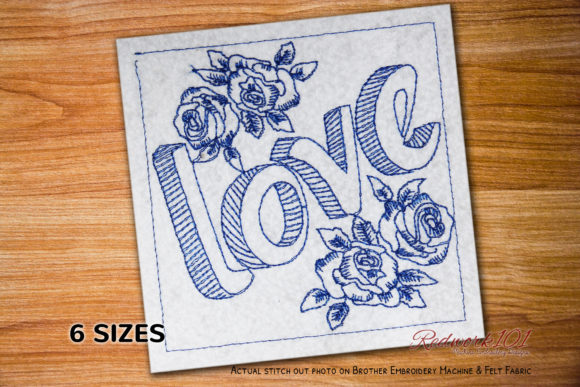
When I opened Love with 3d Flowers for the first time, what struck me wasn’t just the theme—it was the quiet confidence in its construction. This isn’t a flat script or a generic heart motif. It’s a layered composition where floral elements rise subtly off the fabric plane, suggesting depth without overloading stitch count. The “3D” here feels earned—not through excessive puff or foam, but through smart satin stitch direction, gentle fill gradients, and intentional spacing between petals. It reads as warm and handmade, not digital or stiff—exactly the tone you want for a Valentine’s Day embroidery file meant to land on real products, not just screens.
Real-World Test: A Custom Linen Tea Towel for a Local Boutique
Last week, I stitched Love with 3d Flowers onto a natural linen tea towel for a small-batch kitchen goods shop. No embellishments—just the design centered at 4.2" wide, using 40-weight cotton thread and medium tear-away stabilizer. The result? A piece customers paused to touch. The raised petal edges caught light differently than the smooth “love” lettering, creating tactile interest that photos rarely convey. That’s the strength of this machine embroidery design: it translates beautifully from screen to stitch, and from stitch to shelf.
Where It Shines—and Where to Pause
Love with 3d Flowers works exceptionally well on structured, medium-weight fabrics: canvas tote bags, cotton sweatshirts, denim aprons, and pillow covers hold its shape without distortion. On baby onesies or lightweight cotton tees, I recommend reducing size slightly (under 3.5") and adding lightweight cut-away stabilizer underneath—especially around the outer flower curves, where tension can pull delicate satin stitches.
It’s also a strong candidate for embroidered patches. The outer outline (the optional Box Stitch mentioned in the description) gives clean edge definition when heat-applied or sewn on—ideal for craft fair merchandise or boutique branding. But skip it on curved surfaces like baseball caps unless you’re confident in your hooping technique and have tested on scrap first. The floral density near the top “L” and bottom “e” needs stable, flat real estate to resolve cleanly.
Fabric & Context Notes You’ll Want to Remember
- Dark fabric? Test thread contrast early. The inner floral details rely on subtle tonal shifts—on navy or charcoal, use a cream or pale blush thread for the petals, not stark white.
- Stretchy fabric? Always pair with cut-away stabilizer and consider shortening stitch length by 0.2mm for tighter control on knits.
- Washability matters. If stitching for baby items or kitchen towels, avoid overly dense fill areas—Love with 3d Flowers balances this well, but double-check the center of the largest bloom for any unintentional stacking of satin rows.
- Hoop size. Though not specified, the layout suggests it fits comfortably in a 5x7 hoop at standard size. If you’re planning smaller applications—like a pocket detail on a child’s apron—zoom into the file and confirm legibility of the “love” script before resizing down past 2.8".
What It Adds to Your Finished Product—Beyond Aesthetics
Using Love with 3d Flowers does more than decorate—it elevates perceived value. Customers recognize craftsmanship in dimensionality. That slight lift in the petals signals care, intention, and skill—not just speed or automation. For Etsy sellers and handmade shop owners, that translates directly to higher trust and willingness to pay a premium for personalized gifts or small shop products.
It also supports brand consistency. Whether you’re building a seasonal collection (Valentine’s Day, Mother’s Day, spring nursery decor) or a signature line of embroidered kitchen textiles, this design carries a cohesive mood: tender, artisanal, quietly joyful. It doesn’t shout—it invites closer looking. That makes it ideal for printable mockups too: the interplay of texture and negative space photographs cleanly across light and dark backgrounds.
Practical Designer Checks Before You Stitch
Before committing to a client order or bulk run, do these five things:
- Run a test on scrap fabric matching your final product’s weight and weave—linen behaves differently than cotton poplin, and both behave differently than terry cloth.
- Check thread color contrast in both natural and artificial light. What reads as soft pink in daylight may vanish under fluorescent retail lighting.
- Zoom into the file and inspect corners—especially where the “v” in “love” meets the first flower stem. Running stitch anchors there should be visible and secure, not buried under fill.
- Review stitch density in the flower centers. High density adds richness but increases wear risk on frequently washed items—adjust if needed for commercial embroidery durability.
- Confirm licensing. Since Love with 3d Flowers is positioned as an embroidery file for creative entrepreneurs, verify whether it permits resale of finished products (yes, in most cases) and whether digital redistribution—like bundling it into a craft course—is allowed.
Final Thought: Not Just for February
Yes, Love with 3d Flowers fits perfectly in a Valentine’s Day collection—but don’t box it in. Its warmth and tactility make it equally compelling for baby shower gifts (stitched on a muslin swaddle), wedding favors (on linen napkins), or even spring-themed boutique branding. As a designer and embroidery product reviewer, I keep returning to how thoughtfully balanced it is: romantic without being saccharine, dimensional without being fussy, detailed without sacrificing clarity. That balance is rare—and valuable—when you’re building a craft business, one stitched piece at a time.